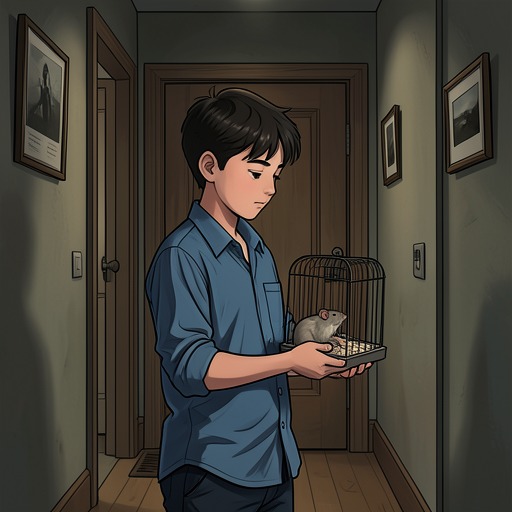
Toby
The Curious Incident of the Dog in the Night-TimeToby is Christopher’s pet rat, a companion whose care remains part of Christopher’s routines even when his home life breaks down. During Christopher’s flight from home, Toby becomes more than something to protect: carrying and searching for him gives Christopher a concrete responsibility to pursue through an unfamiliar and frightening journey.
Identity and Everyday Care
Christopher identifies Toby as his pet rat and keeps three pellets of rat food among the objects in his pockets. At home, he lets Toby out of his cage and gives him a carrot, a small domestic routine that follows a tense drive with Father. Later that night, Christopher goes downstairs for a drink and finds Father crying, then asks whether he is sad about Wellington. The contrast between the household’s emotional turmoil and Christopher’s specific act of feeding Toby places the animal within the ordinary structures of care on which Christopher relies.
Toby also appears in Christopher’s account of how people communicate. Christopher finds unspoken signals difficult to interpret, and explains that Siobhan describes how the meaning of a raised eyebrow or a breath through the nose can depend on many surrounding details. Toby’s relationship with Christopher is not presented through such uncertain social signals: feeding him and keeping him safe are direct tasks with clear practical consequences. This contrast supports the importance of Toby as a companion in a world Christopher often experiences as confusing, without requiring the rat to be treated as a symbol alone.
Departure from Home
When Christopher decides to leave, he plans around Toby’s needs as well as his own. He gathers both coats and a scarf because it is cold outside, then returns upstairs for Toby’s cage. Hearing Toby scratch, he places one of the coats over the cage to quiet the noise while Father is asleep. He carries Toby downstairs, takes his special food box, and slips out through the back door, carefully holding the handle so it will not click loudly.
At first, Christopher asks Mrs. Alexander, who lives next door to Mrs. Shears, whether she will look after Toby. She does not know who Toby is, so Christopher explains that Toby is his pet rat. She invites Christopher inside to talk and work out what would be best, but he refuses to enter and asks again whether she will take care of Toby. She says that she does not think it would be a good idea. Christopher says nothing in response. The brief exchange shows that his request is not simply an attempt to find someone to hold the animal: he is under pressure to leave, yet keeps asking for a reliable arrangement for Toby.
Christopher then sees Father’s mobile phone, wallet, and address book on the kitchen surface. He initially fears Father may be back, but checks his remembered image of the house and realizes Father’s van is gone. He takes Father’s bank card, which he can use to get money, and makes a further adjustment to his plan: the cage is too heavy to carry all the way to London, so he removes Toby from it and puts him in a coat pocket. He leaves through the kitchen door and heads toward the school, hoping to ask Siobhan where the train station is. Toby’s safety is thus bound to Christopher’s practical decisions about weight, concealment, money, and route.
The Railway Station and Rescue
At the station, Christopher sits for hours with his eyes closed, trying to make the place feel less present and more like the safety of his bed. When he eventually checks his watch, it is 8:07 p.m.; he has been there for approximately five hours and is hungry and thirsty. Only then does he realize Toby is no longer in his pocket. Away from both parents’ homes, Christopher fears that nobody will feed the rat and that Toby may die or be run over by a train.
Christopher searches the station and its passageways, then looks down toward the tracks. He sees two dirty mice but continues looking because neither is Toby. He recognizes Toby by his white fur and the brown, egg-shaped mark on his back. Toby is below, eating an old sweet wrapper. Christopher climbs down from the concrete to reach him, despite someone shouting at him to get out of the track area. When Toby runs away from his first attempt to catch him, Christopher follows, calls his name, and holds out his hand for Toby to smell and recognize. The search is focused and specific: Christopher distinguishes Toby from the other animals by the mark on his back and tries to draw him close through familiarity rather than force.
Attachment and Narrative Significance
Toby’s disappearance changes the immediate stakes of Christopher’s journey. Christopher has already accepted the risks of leaving home and traveling toward London, but the missing rat introduces a danger he cannot dismiss: Toby may be left without food or struck by a train. The episode makes Christopher’s attachment legible through action—his repeated efforts to arrange care, his decision to carry Toby himself, and his willingness to descend toward the rails to find him.
The episode also gives Toby a concrete presence beyond Christopher’s feelings. He scratches in his cage, eats the discarded sweet wrapper, moves away when Christopher tries to catch him, and is identified by his distinctive coloring and marking. The novel does not provide Toby’s point of view, but these details establish him as a living animal whose needs and movements shape Christopher’s choices. His care is therefore both a relationship and a practical obligation, one that persists when familiar homes and routines are no longer available.